




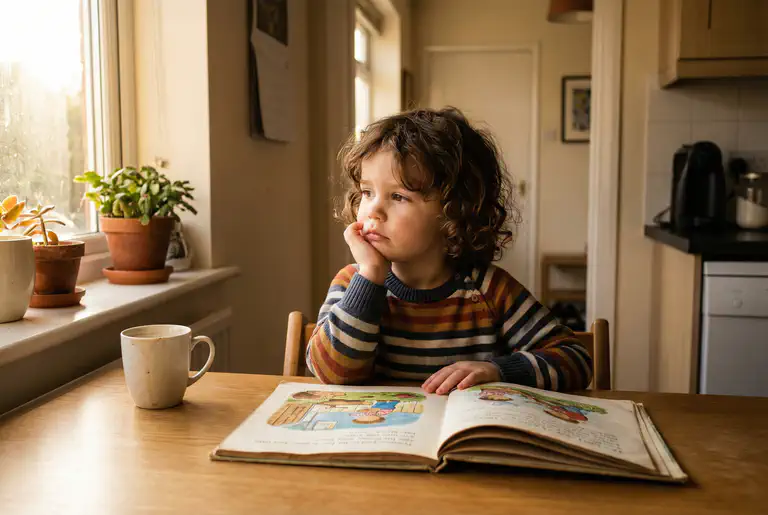
My son went through a phase where he would do almost anything to avoid reading aloud. He would suddenly need the bathroom, remember a toy he had lost, develop a fascination with whatever was happening outside the window. It was not that he could not read — he could, haltingly — but the experience of stumbling over words in front of someone had become something he dreaded.
I tried everything. Reward charts. Different books. Reading before bed, reading after breakfast, reading in the car. Nothing shifted the pattern until I came across a technique in the research literature that sounded almost too simple to work.
It is called paired reading.
What Is Paired Reading?
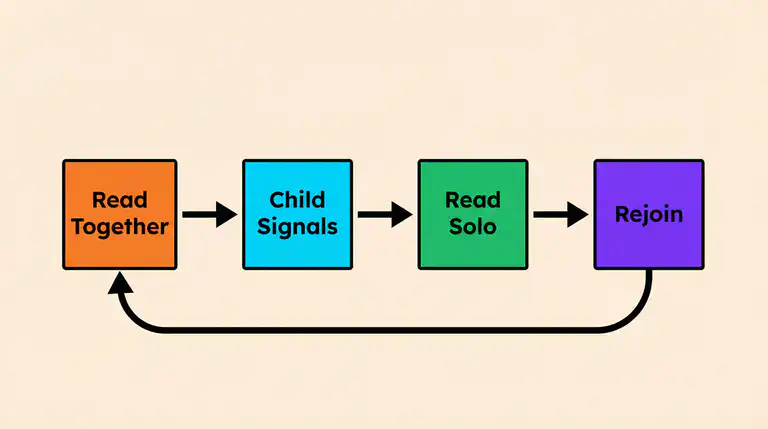
The idea is straightforward. You sit beside your child with a book, and you both read aloud together, at the same time, at their pace. Your voice becomes a kind of scaffold — always there, always keeping things moving. When your child feels confident enough to go it alone, they give you a signal. A tap on the table, a knock on the book, whatever you agree on. Then they read solo while you listen.
Here is the part that makes it different from just listening to your child read: if they get stuck on a word, you do not wait in tense silence while they sound it out. You simply join back in and read together again until they signal once more that they are ready.
That safety net changes everything.
When I first tried this with my son, I was sceptical. It felt too passive on my part — was I not just doing the reading for him? But within a few sessions I noticed something. He was signalling to read solo more and more often. The simultaneous reading was not replacing his effort; it was giving him the confidence to attempt words he would previously have avoided. He stopped dreading it. Some evenings he actually asked to keep going.
What the Evidence Tells Us
I am not the only one who has noticed this. The benefits of paired reading have been studied extensively, and the results are remarkably consistent.
A large-scale randomized controlled trial funded by the Education Endowment Foundation tested a structured paired reading intervention across 131 schools and more than 6,000 Year 5 pupils in England (Tymms et al., 2011). Children in the paired reading groups made the equivalent of two additional months of reading progress compared to those who did not participate. Two months might not sound dramatic, but for a struggling reader, two months can be the difference between falling further behind and starting to close the gap.

The evidence does not stop there. A 2024 multilevel meta-analysis — a study that pools results from many individual trials to find the overall pattern — examined what researchers now call Synchronous Paired Oral Reading Techniques (Downs & Mohr, 2024). The analysis found medium-to-large positive effects on both reading fluency and comprehension. It did not matter whether children were paired with adults, older students, or same-age peers. The approach worked across all of them.
Earlier research by Topping and Lindsay (1992) found that paired reading produced gains averaging 1.5 times those of comparison approaches. And the What Works Clearinghouse, which reviews education research for the US Department of Education, reported an effect size of 0.91 for reading comprehension in peer-assisted programmes (Saenz et al., 2005). To put that number in context: it means children receiving the paired reading intervention made nearly a full year’s extra progress in comprehension compared to those who did not.
But there are other benefits to paired reading beyond the numbers.
Both readers gain from the experience. The stronger reader develops deeper comprehension through modelling and explaining, while the developing reader builds fluency and confidence. This is one of the most consistent findings in the literature — paired reading is not charity. It is a genuine exchange. If you have an older sibling reading with a younger one, both of them are growing as readers.
Paired Reading Strategies That Work at Home
So how do you actually do this? Here are paired reading strategies for parents that I have found effective, drawn from the research and from what has worked in our own house.
Let your child choose the book. This matters more than you might think. A child who is interested in the story will tolerate the difficulty. Even if the book seems slightly above their level, that is actually ideal — your voice alongside theirs bridges the gap.
Start every session reading together. Do not skip the simultaneous reading phase, even if your child seems keen to go solo right away. Reading in unison for the first few minutes builds rhythm and settles them into the text. Match your pace to theirs, not the other way around.
Wait before you help. When your child is reading solo and stumbles, give them 3 to 4 seconds before you step in. That pause is where self-correction happens. It is tempting to jump in immediately — I still have to remind myself not to — but those few seconds of productive struggle are where the learning lives.
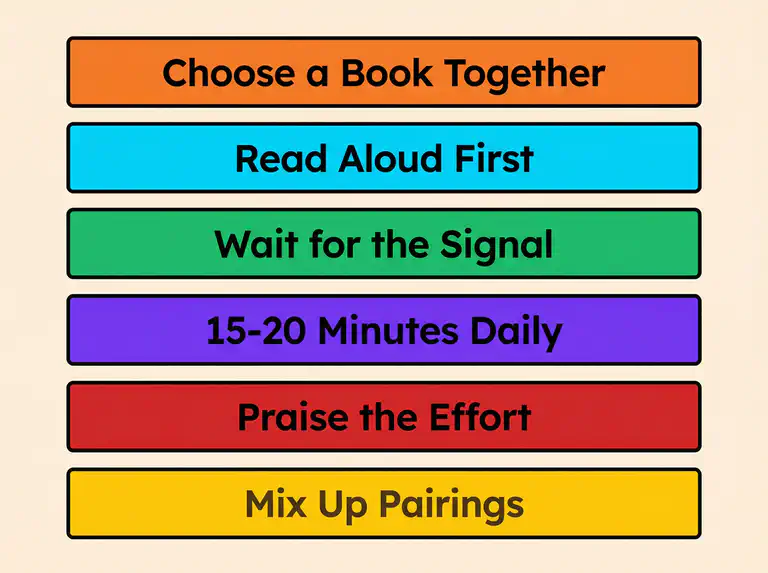
Keep sessions short. Research consistently shows that 15 to 20 minutes of daily paired reading produces the strongest results. Short and regular beats long and occasional every time. We do ours after dinner, before screens. It has become part of the routine rather than a special event, which is exactly the point.
Talk about the story, not just the words. Ask what they think will happen next. Comment on a character’s decision. Laugh at the funny parts together. Paired reading activities work best when they feel less like a reading lesson and more like a shared experience. The comprehension benefits follow naturally from genuine engagement with the text.
Mix up the pairings. The research found benefits from both cross-age and same-age pairings. Grandparents, older siblings, a confident friend from school — they can all serve as effective reading partners. Different voices and different dynamics keep paired reading examples fresh and prevent it from feeling stale.
What We See at Bookbot
At Bookbot, we look at data from thousands of children learning to read, and one pattern stands out above everything else: consistent, supported practice is the single most important factor in progress. Paired reading delivers exactly this. A child who reads aloud with a supportive partner every day will improve. The research is unambiguous on that point.
This is also the principle behind Bookbot itself. The app uses speech recognition to listen as a child reads aloud through a library of levelled, phonics-aligned books, providing immediate feedback and support. In a sense, it mirrors the paired reading approach — the child is never alone with a word they cannot manage. Both methods share the same core insight: children read better when they know someone (or something) has their back.
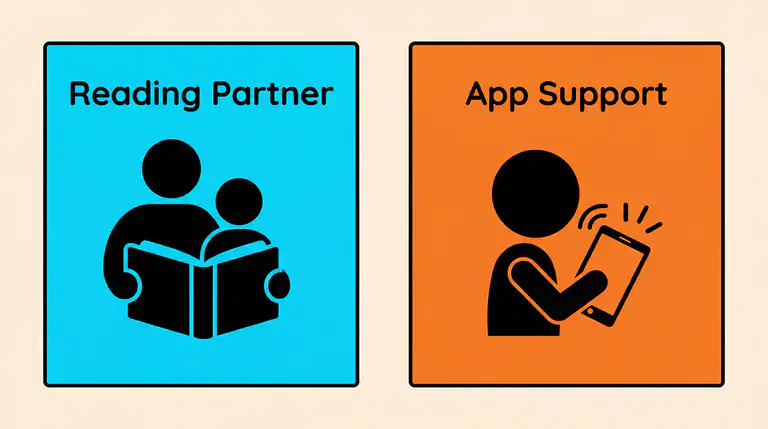
For the times when a parent or reading partner is not available, an app like Bookbot can complement paired reading for parents by giving children another way to practise reading aloud with structured support. That is what we focus on at Bookbot and Flinders University: making sure every child has access to evidence-based reading support, in whatever form works best for their family.
A Small Thing That Made a Big Difference
My son still has evenings where he would rather do anything than read. He is a child, not a research subject. But the dynamic has shifted. He no longer sees reading aloud as a test he might fail. It has become something we do together — sometimes with me, sometimes with his older cousin, sometimes with Bookbot on the iPad when I am cooking dinner.
If your child is finding reading tough, try paired reading this week. Sit beside them, read with them, and let them tap the table when they are ready to fly solo. You do not need special training or expensive materials. You need a book, fifteen minutes, and the willingness to read aloud alongside them — even when it feels like you are doing all the work. You are not. They are listening, absorbing, building the confidence to try.
The research says it works. In our house, it did.
References